
do opposites really attract?
what a massive study of real couples says about the old dating cliché
"Opposites attract" is one of those dating clichés that gets repeated so often it starts to feel like fact. The chaotic extrovert paired with the quiet introvert. The night owl who somehow ends up with the early riser. It makes for a good rom-com pitch, but does it hold up when you actually look at who ends up together long-term?
A team led by researcher Tanya Horwitz at the University of Colorado Boulder decided to find out for real. Published in Nature Human Behaviour in 2023, the study pulled together a systematic review of 22 traits from 199 prior studies covering millions of couples, some dating back to 1903, and then ran a fresh analysis on 133 traits using UK Biobank data from roughly 80,000 opposite-sex couples. That's one of the largest looks at partner similarity ever assembled, and the results are pretty clear.
the short answer: not really
Across the traits studied, somewhere between 82% and 89% showed a positive correlation, meaning partners were more alike than you'd expect from two random people. Only about 3% of traits showed the reverse pattern, where partners were less alike than chance would predict. As Horwitz put it, "birds of a feather are indeed more likely to flock together."
That doesn't mean couples are identical, and it doesn't mean similarity is why people fall for each other in the first place. Correlation isn't the same as cause, and the study on its own can't tell us whether people seek out partners who resemble them or whether years together just make couples grow alike. But as a description of who actually ends up paired off, the opposites-attract idea doesn't get much support here.
why would partners end up alike in the first place?
The researchers point to three overlapping explanations, and none of them require any conscious plan to find a lookalike.
Some of it is just geography and social circles. People often grow up in the same town, go to the same schools, work in the same industries, or move in the same friend groups, so the pool of people they're likely to date is already filtered toward people somewhat like them before a first date ever happens.
Some of it is genuine preference. People are, on average, drawn to partners who share their values, habits, and interests, whether or not they'd describe it that way.
And some of it happens after the relationship starts. Years of sharing a home, a schedule, a diet, and a social life can nudge two people's habits and even some attitudes closer together over time.
The study can't fully separate these three effects from each other, which is part of what makes the results interesting rather than obvious. As Horwitz put it, "these findings suggest that even in situations where we feel like we have a choice about our relationships, there may be mechanisms happening behind the scenes of which we aren't fully aware."
where couples are most alike
Some traits showed much stronger pairing than others. Birth year led the list, which makes sense since most couples meet within their own general age range. Right behind it came political values, religious beliefs, education level, and general intelligence. Substance use habits, like how much a person drinks, also tracked closely between partners.
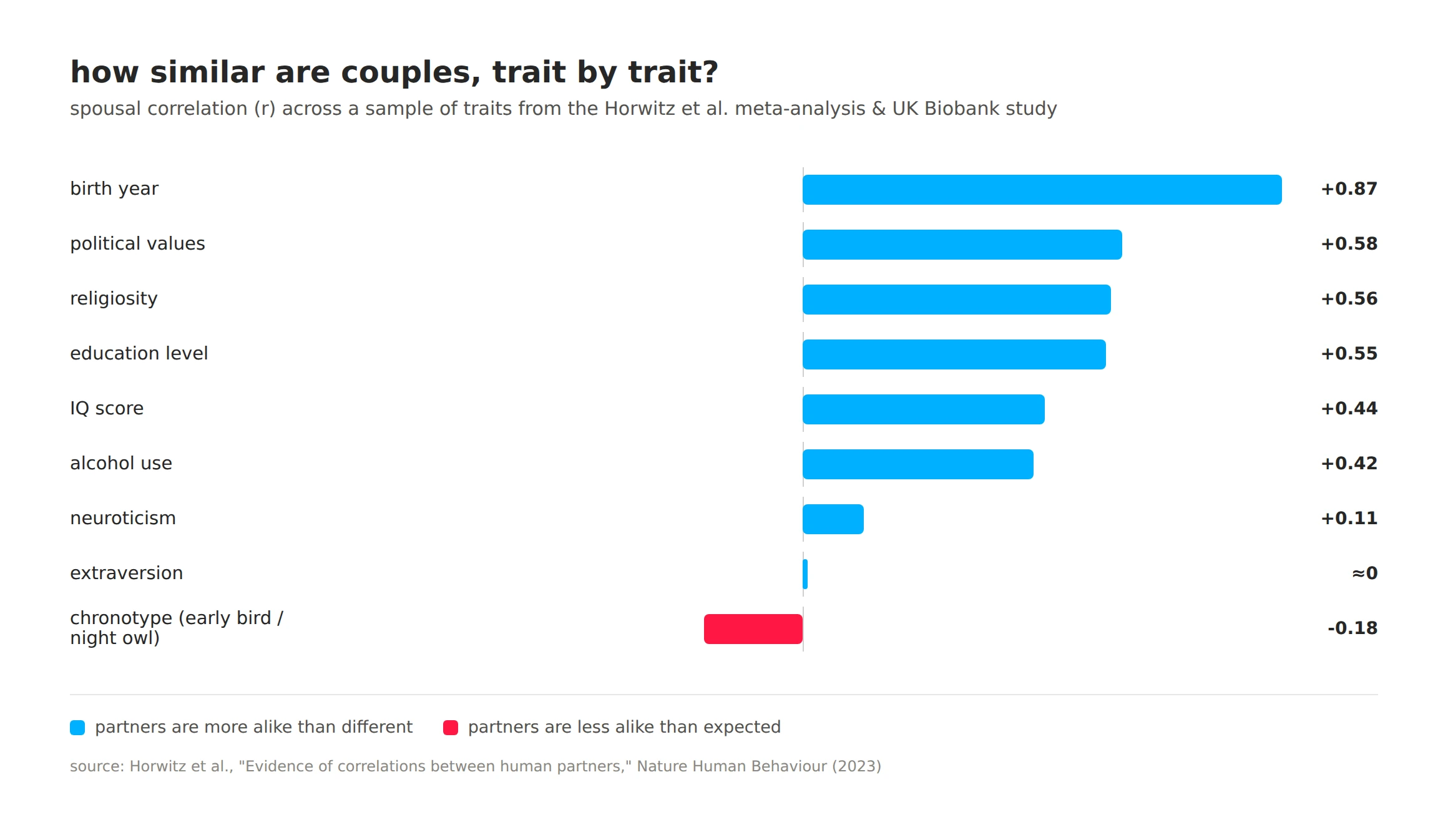
None of this is hugely surprising once you think about it. Politics and religion often shape the communities, families, and social circles people meet partners through in the first place, and education level tends to correlate with the environments people spend time in during their twenties, when a lot of relationships form. Similar reasoning likely applies to drinking habits: people who go to bars regularly tend to meet other people who go to bars regularly.
Physical traits like height and weight, along with various medical conditions, also showed positive correlations between partners, just weaker ones than the categories above. It's a smaller effect, but it's there.
where the "opposites" idea holds up a little better
Personality is where things get more interesting. Traits like neuroticism and extraversion, two of the Big Five personality dimensions, showed only weak correlations between partners. In other words, whether you're anxious or easygoing, outgoing or reserved, doesn't predict much about your partner's personality on those same scales.
A handful of traits even leaned slightly negative, meaning partners were a little less alike than random chance would suggest. Chronotype, or whether someone is a morning person or a night owl, was one of them. So was a tendency to worry and difficulty with hearing. These effects were small, and the researchers were careful to note they need more investigation before drawing big conclusions. But it's a rare bit of quantitative support for the idea that some couples really do balance each other out, at least on a few specific traits.
why researchers care beyond curiosity
This isn't just a fun trivia result. Senior author Matt Keller pointed out that a lot of genetics research assumes people pair up randomly when it comes to traits like height, intelligence, or disease risk. "A lot of models in genetics assume human mating is random," he said. "This study shows this assumption is probably wrong." When partners are correlated on a trait, that trait can look more heritable than it really is, which matters for anyone trying to untangle genes from environment in large studies.
There's a social angle too. If people are pairing up along lines like education and income, and those traits keep sorting couples into similar categories generation after generation, that pattern can reinforce existing gaps between groups over time rather than mixing people across them.
so does that mean opposites never attract?
The traits where opposites tend to pair up are a small minority, and they're mostly not the traits people usually mean when they use the phrase. Nobody swipes right because someone lists "different chronotype than me" in their bio.
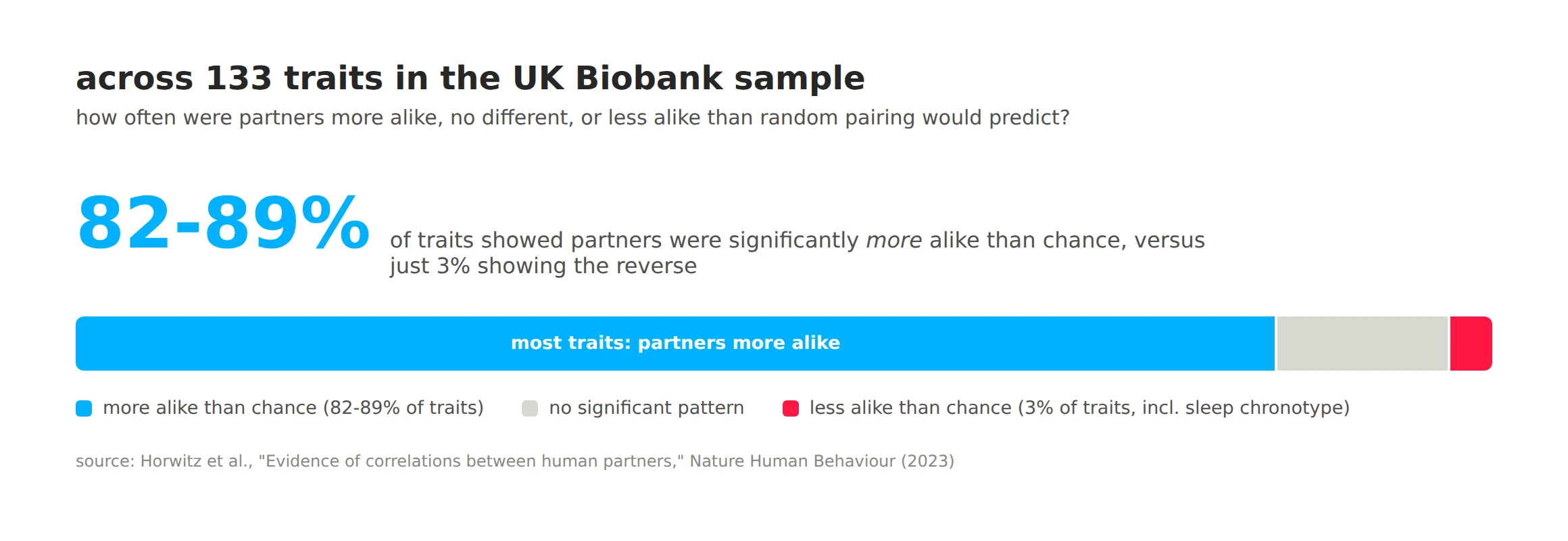
It's also worth remembering that "more alike than chance" still leaves a lot of room for difference. A correlation of 0.58 for political values is strong by social science standards, but it's far from a perfect match. Plenty of couples land on opposite ends of a trait even when the overall population trend points toward similarity. Averages describe millions of couples; they don't describe yours.
final thought: so, do opposites attract?
Mostly not. The data says people tend to end up with partners who share their values, their habits, and a good chunk of their personality, especially in the categories that shape day-to-day life together, like politics, religion, and how you spend a Friday night. The handful of traits where couples differ, like sleep schedule, are real but modest, and probably say more about compromise than chemistry.
If you've ever felt like you and your partner are basically the same person with different faces, the research suggests you're not imagining it. And if you've matched with someone whose politics, values, or life goals feel miles from yours, this data is a reasonable nudge to pay attention to that gap. It's less likely to resolve itself than the movies make it seem.
find someone who's actually on your wavelength
This is basically the whole idea behind Polar Social. Instead of guessing at compatibility from a handful of photos, you match with people based on the values, opinions, and interests you actually share, the same kinds of traits this study found matter most. Download Polar on iOS or Android and find your person.
keep reading

everyone says dating apps are dead. the receipts say otherwise
the burnout posts are real. so is the wedding data. here's both
september 18, 2026
is your match actually texting you, or is it chatgpt?
inside "chatfishing," the ai dating trend nobody signed up for
august 29, 2026

polar 2.0 is here
a global launch, polar plus, and new ways to match
august 1, 2026